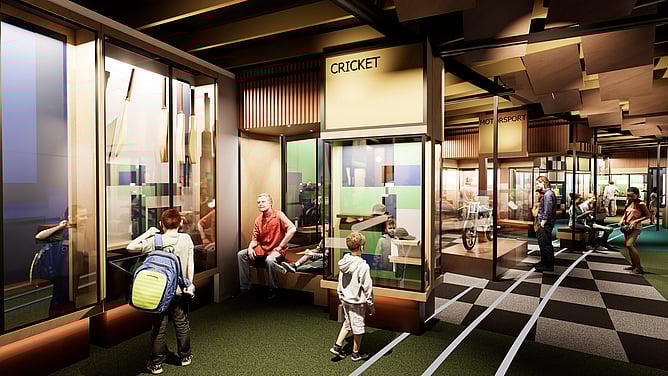
Remember the old Field of Dreams adage: “If you build it, they will come?” Well, the New Zealand Sports Hall of Fame seems set for a brighter future in Cambridge when it shifts there later this year - and more inductions have been promised to coincide with the move.
The hallowed Hall has been based at Dunedin’s ornate Railway Station since 1999, but it closed just after Easter, following just 12 inductions in the past 10 years.
Its future became clouded after the Covid pandemic following funding challenges.
Now the NZ Sports Hall of Fame Trust chaired since 2018 by Dunedin accountant and former rugby referee Stuart McLauchlan - has negotiated a move to Cambridge where the Hall of Fame will be housed in the Grassroots Trust Velodrome, home to Cycling New Zealand.
McLauchlan told the Sunday Star-Times that the exhibits would be packed for a mid-year move to the Waikato and “Cambridge plan to be operating’’ at the end of the year.
While the trust was “very appreciative” of the Dunedin City Council for providing the space rent-free for many years, the move north was “the right thing”.
“We went through a RFP [request for proposal, and Cambridge came through strongly.”
Dunedin had the opportunity to put in a bid, but “couldn’t get the buy-in from the council”.
McLauchlan, a trust board servant since the late 1990s, said Cambridge, with Hamilton and Auckland nearby, had a much bigger catchment area and the Home of Cycling Charitable Trust, which will manage the venue, “can take it to the next level, especially the digital side and interactivity”.
The plans look impressive. The velodrome’s website promises “a new chapter with a modern, dynamic and interactive experience in this vibrant sports hub” in a “cutting-edge interactive space designed to inspire movement through gamified sports activities, bringing the science of athletic performance to life”.
It’s a far cry from the static displays at the Dunedin facility where, despite its downtown tourist precinct setting, just 8000 to 10,000 visited on average in recent years down from over 20,000 in 2009.
The HoF used to get a $100,000 annual grant from Sport New Zealand - which provided close to half its total revenue - but McLauchlan said they had not had that for some time, although the government body continued to be supportive and were contributing to relocation costs.
Honorees and their families, who have loaned memorabilia to the Hall, are also “very supportive of the move”.
Cambridge should get more numbers through the door. The velodrome facility
- to be re-branded the Cambridge Arena reportedly had 180,000 visitors last year.
The Cambridge News has reported that the Grassroots Trust had committed $1.1 million plus $300,000 for operating support and it hoped to attract 30,000 visitors a year at $10 a head (Dunedin’s admissions revenue was around $35,000 in 2019).
But there is more to a Hall of Fame than bricks and mortar and whizzy-bang graphics. You can build a flash house, but it’s got to have occupants. The HoF has 175 individual inductees (143 men and 32 women) and 15 teams - but has added just 36 individuals and two teams since 2000.
McLauchlan acknowledges that it is hightime more athletes are honoured - a process that had stalled since long-serving chief executive Ron Palenski’s passing in 2023 and while officials were preoccupied with the Hall’s pending move.
Rugby great Richie McCaw and Olympic shot put champion Dame Valerie Adams were inducted to the HoF at this year’s Halberg Awards - the first elevations since Palenski in 2022.
The NZ Sports Hall of Fame Trust will continue to drive the induction process.
McLauchlan and David Howman, a former WADA (World Anti-Doping Agency) secretary-general, have been joined by four new directors, including Athletics New Zealand chief executive Cam Mitchell, Sport Otago CEO James Nation and Waikato-based lawyer Suzanne Mace, head of legal for Rabobank.
The New Zealand Sports Hall of Fame began with a glitzy televised induction ceremony in December 1990, funded by a $440,000 Lottery Grants Board grant. Sixty-six individuals and seven teams were inducted.
Luminaries included Olympic champions Yvette Williams, Peter Snell, Murray Halberg, Jack Lovelock and John Walker, rugby legends like Brian Lochore, Wilson Whineray, Colin Meads and George Nepia, cricket greats Richard Hadlee, Bert Sutcliffe, John Reid and Glenn Turner, late, great motor racing ace Bruce McLaren and netball’s Joan Harnett.
But the pioneering Class of 1990 had an eclectic element - record-breaking aviator Jean Batten, mountaineer Sir Edmund Hillary, world champion shearer Godfrey Bowen, yacht designer Bruce Farr, softballer Kevin Herlihy, speedway rider Barry Briggs and gun lawn bowlers Phil Skoglund and Elsie Wilkie all made the cut - recognition of the value of grass-roots sports.
Induction ceremonies continued apace through the 1990s. By the end of the decade 139 athletes and 13 teams had been honoured.
Yet they have slowed to snail’s pace since. That rankles with Joseph Romanos, the Hall of Fame’s former executive director from 1995 to 1998 until it shifted to Dunedin.
Romanos sat down with the Star-Times this week and produced a list of 162 athletes, coaches, teams, administrators and sports media personalities who he suggested had legitimate claims to Hall of Fame inclusion.
“I’ve put an asterisk beside the ones I feel are obvious inclusions and glaring omissions,” he said.
“There’s a lot of catching up that needs to be done. How people like Hamish Carter, Blyth Tait, the Evers-Swindell [twins], Mahe Drysdale, Hamish Bond, Bond-Murray, Michael Campbell, Dan Carter, Daniel Vettori,
Stephen Fleming, etc are not in there is totally beyond me.”
Romanos finds it incredulous that the late John Davies, a 1500m bronze medallist at the 1964 Tokyo Olympics behind gold medallist Snell - is yet to be inducted when other athletes who never earned Olympic medals have been.
His “asterisk” category also features netballers Irene van Dyk, Laura Langman, Casey Kopua and Maria Tutaia (Folau), twotime Olympic triathlon medallist Bevan Docherty, boxer David Tua, rowing coach Dick Tonks, All Black Zinzan Brooke and World Cup footballers Ryan Nelsen and Winston Reid, to name just a few.
Sailing has been one of New Zealand’s most successful sports, yet there is still no place in the Hall for Russell Coutts and Grant Dalton.
Romanos also believes there’s a case for legendary sportswriter T P McLean and broadcaster Keith Quinn.
McLauchlan agrees with Romanos that there is “some catching up to do’’ and said the trust will honour more athletes at “a celebration that may dovetail with the move to Cambridge”.
The Hall of Fame website says it now has inductions at least every two years , but in the last 10 years just 12 people have been honoured - from rowing administrator Don Rowlands, netball Lesley Rumball, softballer Mark Sorenson and jockey Lance O’Sullivan in 2016 through to McCaw and Adams in 2026.
Since 2020, just former All Blacks halfback Sid Going, Palenski himself, Adams and McCaw have been inducted.
McLauchlan said they would have liked to have inducted more, “but the issue is the cost”.
“As an organisation we haven’t got the money. So it works very well [to have inductions] with the Halbergs.”
He promised “more than two people’’ will be honoured at future ceremonies, but exact details are yet to be confirmed.
McLauchlan pledged the trust would continue to have an independent panel to recommend future inductions.
The panel used to comprise three inductees, three representatives from sports organisations and three members of the media.
But McLauchlan said after a constitution change the panel no longer includes journalists, although media were consulted “over Ron’s induction” in 2022.
Romanos believes media bring a broader perspective and said it was important that the panel meet to discuss nominations.
Nominees have to be elite sports achievers who have been out of international competition for five years.
McLauchlan said nominations should come from sporting organisations and he “would like to see them be more proactive in vetting their members” to ensure they meet the criteria.
So who should be added to the Hall of Fame?
It’s important that the trust must avoid the risk of recency bias. The Hall must also not become an exclusive enclave of Olympians and professional sports practitioners.
As well as Olympic champions, All Blacks, Black Caps and Silver Ferns, Romanos makes a compelling case for multiple world champion wood choppers Jason Wynyard and David Bolstad, wool handler Joanne Kumeroa and decorated shearer David Fagan, shooters, Black Sox and White Sox softballers and Black Jacks bowlers.
The teams category could be expanded to include the 1995 America’s Cup crew, back-to-back Olympic rowing champs Bond and Murray and Caroline and Georgina Evers-Swindell, yachting’s Jo Aleh and Polly Powrie, the 1993 world champion Silver Ferns netballers - all on the Romanos list - plus the 1982 All Whites (first to reach a World Cup finals) and their 2010 counterparts (unbeaten at the tournament) and the 2002 Tall Blacks, who finished fourth at the world championships.
While McLauchlan said there won’t be “mass inductions” as seen in the 1990s, the list will grow and it is important the Hall of Fame reflects New Zealand’s rich sporting heritage.
This article has been quoted in full from: https://www.pressreader.com/new-zealand/sunday-star-times/20260412/282651809053791
To stay connected with this project, you can visit our website here.